Most drug safety vendor lists are long and unscored. They tell you who exists, not who fits. If you are an emerging biotech with a product heading from trials towards a first approval, you need to know which partner can find a safety signal, judge it properly and carry the answer through to your label and risk management plan.
We assessed 30 drug safety and signal detection vendors against that one brief, scored 26 of them on published criteria, and showed what changes when the brief changes. Every score links back to the vendor's own pages, and the full scorecard is editable.
Quick answer
- Best overall for this brief: VCLS scored 95.0 out of 100. It is the only vendor with full marks on all six criteria covering signal method, regulatory and labelling links, development safety, aggregate reports, biotech fit and integration.
- Closest alternative: ProPharma scored 94.0, with full marks on seven of eight criteria and EVDAS, FAERS and VigiBase named as signal sources. It lost points only for having no dedicated emerging-biotech offer.
- Best large CROs for trial-to-market safety: Fortrea, Syneos Health and ICON tie on 90.0, with named signal platforms and biotech offers, though none of them names GVP Module IX or CIOMS VIII.
- Best for a mature marketed portfolio: ProPharma, Arriello and Cencora PharmaLex all score 100 when data, tools, literature and QPPV coverage carry the weight. On that view VCLS falls to 15th.
The brief we scored against
Every score in this guide answers one question: which vendor best suits an emerging biotech that needs signal management tied to regulatory and labelling decisions, from clinical development through to post-market?
That buyer usually has no in-house safety physician and no signal committee. It needs a partner that can run detection and validation, write the assessment, and sit with regulatory affairs when a confirmed risk has to reach the label, the risk management plan or a regulator.
If you already market several products and mainly need signal operations at volume, skip to change the brief, change the winner. The ranking changes a lot.
Why a long vendor list is not a shortlist
Directory-style lists of 50 or 100 drug safety vendors are useful for discovery, but they mix very different businesses: global CROs, specialist pharmacovigilance firms, regulatory consultancies, software houses and device makers. They rarely say what was checked, so two entries with the same label can mean very different things.
A shortlist needs three things a directory does not give you: a defined buyer, a scoring method you can see, and a source for every claim. That is what the rest of this guide provides.
How we picked and scored 30 vendors
We started with 30 vendors drawn from published drug safety vendor directories and our own pharmacovigilance provider research. Three are software companies (Oracle, Veeva and ArisGlobal), so they are described separately and not scored. Insife is now part of Qinecsa, so it is assessed under Qinecsa. That leaves 26 scored service providers.
Each was scored from 0 to 5 on eight weighted criteria, using official pages reviewed on 22 October 2026. A 5 means documented in depth with named methods, tools, teams or case studies. A 3 means a documented service. A 0 means not found. Not found does not prove a vendor cannot do something; it means we could not see it on the pages reviewed, so ask.
| Criterion | Weight | What earned a 5 |
|---|---|---|
| Signal method and frameworks | 20 | A staged process from detection to action, tied to GVP Module IX, CIOMS VIII or FDA guidance |
| Regulatory and labelling link | 15 | In-house FDA and EMA regulatory work linked to labelling, RMP updates or authority communication |
| Development-stage safety | 15 | SAE and SUSAR handling, DSURs, DSMB or safety committee support, safety management plans |
| Emerging-biotech fit | 15 | A dedicated offer, page or case study for small or emerging biotech |
| Aggregate and benefit-risk | 10 | PSUR or PBRER, DSUR and RMP or REMS work |
| Development integration | 10 | Clinical trial operations in-house plus rare disease or cell and gene therapy experience |
| Signal data and tools | 10 | A named safety database or signal tool and named sources such as EVDAS, FAERS or VigiBase |
| Intake, literature and QPPV | 5 | Literature monitoring, adverse-event intake, QPPV or PSMF, PV audits |
Pricing note: we found no public rate card for signal management from any of the 26 vendors, so cost was not scored. This is accurate as of 22 October 2026, and service pages change.
At a glance: the top 10
| Vendor | Best for | Score for this brief |
|---|---|---|
| VCLS | Signal work joined to regulatory, clinical and biotech support | 95.0 |
| ProPharma | Full-scope signal operations with named regulatory data sources | 94.0 |
| Fortrea | Clinical trial signal detection inside a large CRO | 90.0 |
| Syneos Health | Proprietary signal review tools and an FSP model for biotech | 90.0 |
| ICON | Named signal tools and a tailored offer for smaller sponsors | 90.0 |
| QbD Group | A GVP Module IX signal programme with EU and UK QPPV support | 89.5 |
| Arriello | A detailed public signal workflow on Veeva Vault Safety | 89.0 |
| Cencora PharmaLex | Named signal sources and broad safety database experience | 89.0 |
| PrimeVigilance | Named global data sources and cell and gene therapy expertise | 87.5 |
| PPD (Thermo Fisher) | A proprietary signal platform inside a biotech FSP offer | 86.0 |
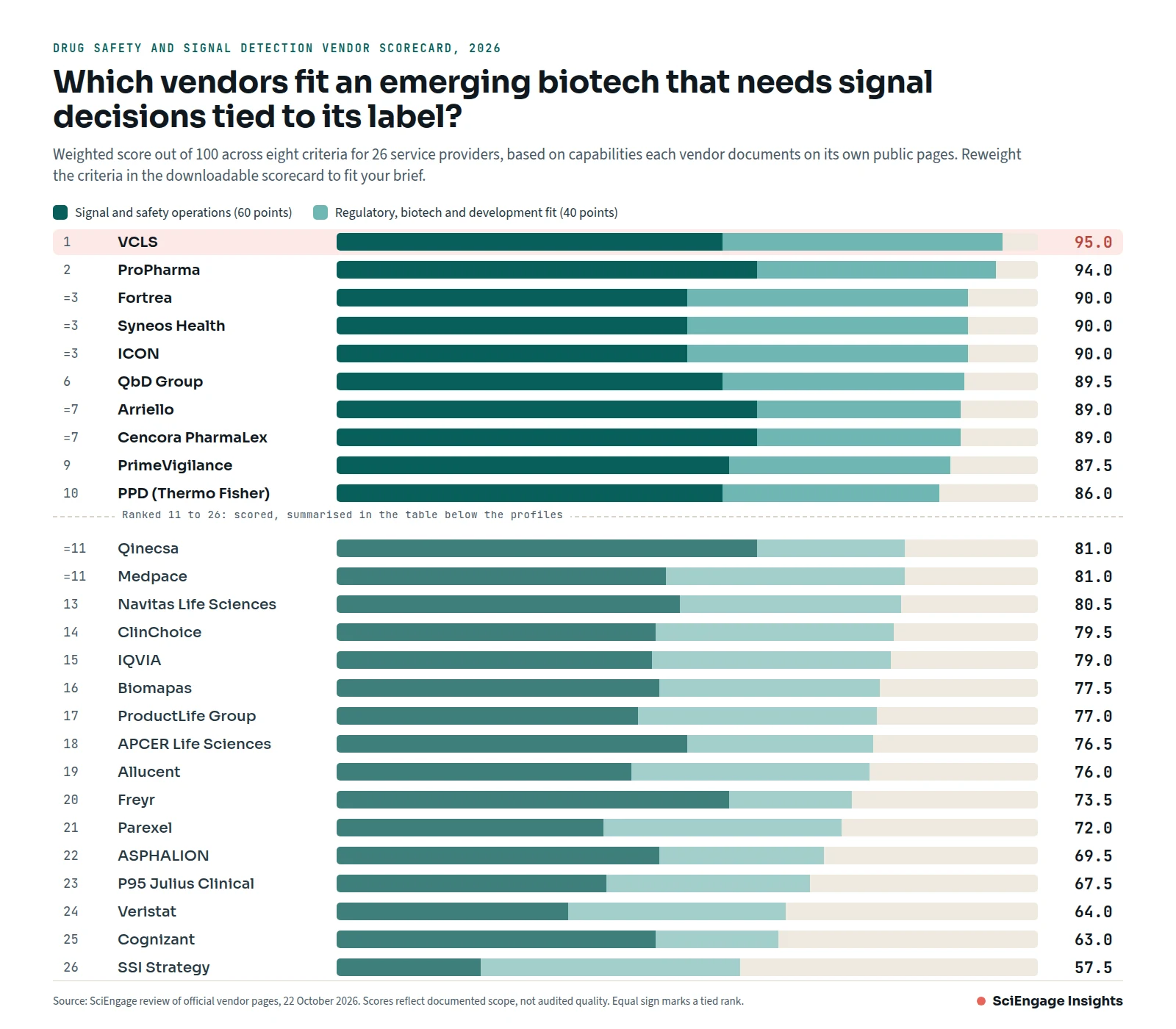
The top of the table is tight. Nine points separate first from tenth, and the order is driven mostly by biotech fit and how much regulatory and clinical work sits in-house. Treat the top 10 as a shortlist to test, not a podium.
What the capability matrix shows
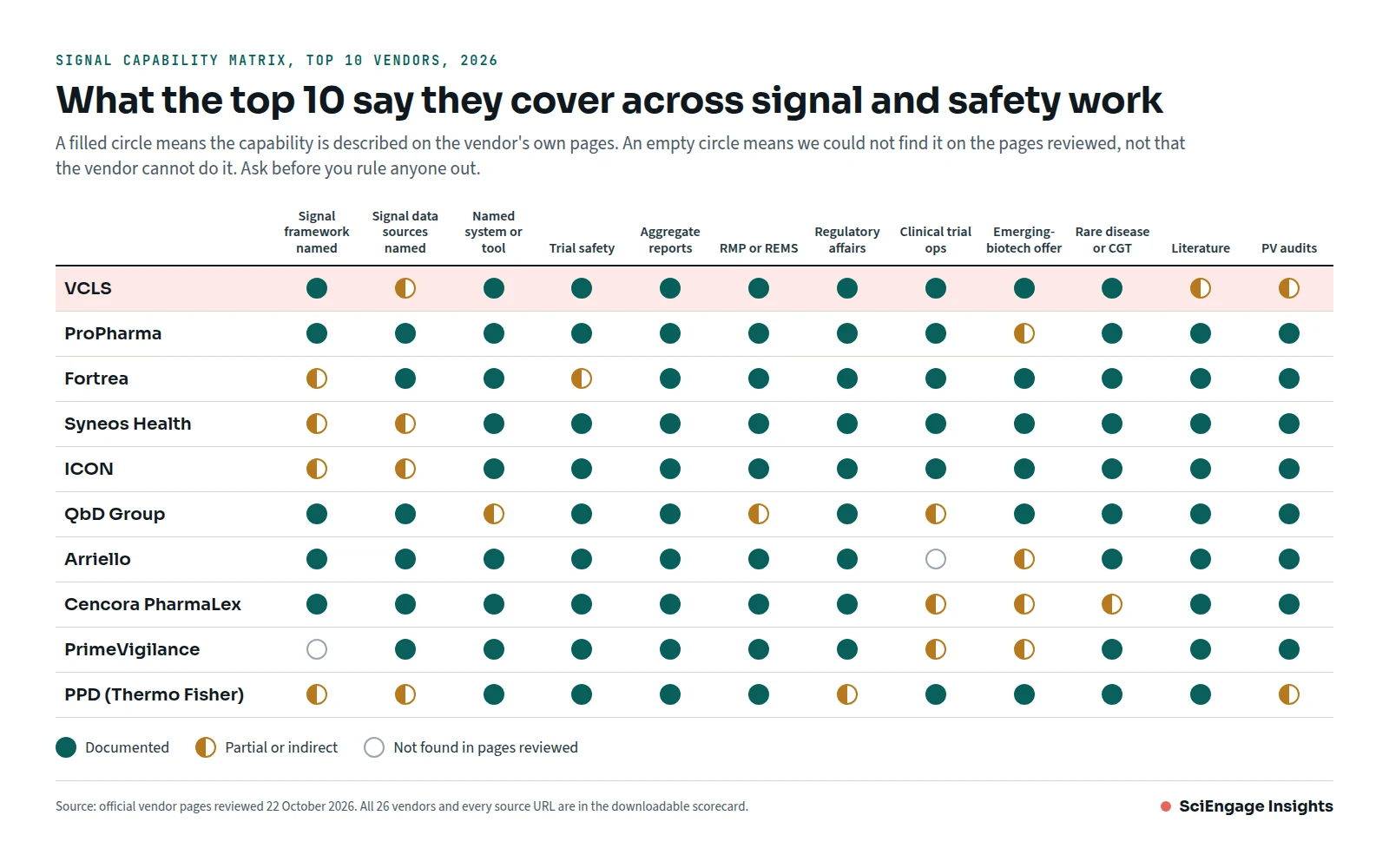
All 10 document aggregate reports, and nearly all document trial safety and RMP or REMS work, so those are table stakes. The differences sit at the edges. Only VCLS, ProPharma, QbD Group, Arriello and Cencora PharmaLex name a signal framework such as GVP Module IX or CIOMS VIII on their public pages.
Named regulatory databases are rarer than you might expect. ProPharma, Arriello, Cencora PharmaLex and PrimeVigilance name sources such as EVDAS, FAERS or VigiBase, and QbD Group names EudraVigilance. Fortrea names clinical, safety and literature sources, while VCLS, Syneos Health, ICON and PPD describe sources in general terms. That is the first thing to ask about in an RFP.
1. VCLS
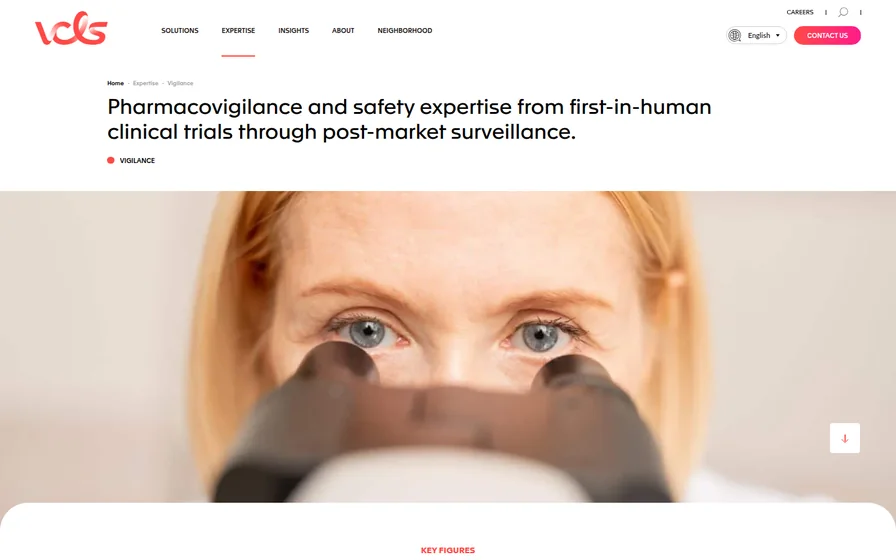
VCLS (Voisin Consulting Life Sciences) is a product-development consultancy that runs regulatory affairs, clinical trials and vigilance as in-house teams. Its vigilance page describes signal identification, investigation and validation under FDA guidance, EMA GVP Module IX and CIOMS VIII, which is the framework detail this brief rewards most.
Score for this brief: 95.0. Equal-weights score: 91.3. Criterion scores (0 to 5): signal method 5, regulatory link 5, development safety 5, biotech fit 5, aggregate 5, integration 5, data and tools 3.5, intake and QPPV 3.
Key features:
- Frameworked signal work: The vigilance page names FDA guidance, GVP Module IX and CIOMS VIII, and places signal work next to RMPs, PSUR, PBRER and DSUR writing, PSMF preparation, QPPV or LPPV appointment and EudraVigilance registration.
- Safety regulatory work in the same team: The same page lists regulatory intelligence, ICSR and aggregate submissions and communication with health authorities, while the regulatory team covers FDA and EMA strategy.
- Trial safety joined to trial delivery: Clinical safety management covers trial case processing, DSMB meetings and safety database configuration, alongside in-house clinical operations.
Pros:
- The only vendor with full marks on all six signal, regulatory, development and biotech criteria
- Dedicated biotech and start-up offers, with 60% of projects in rare disease and gene therapy (self-reported)
- A named safety system: VCLS selected Oracle Argus in January 2026
Cons:
- External signal data sources such as EVDAS, FAERS or VigiBase are not named on its pages
- Literature monitoring is not described as a standalone service
- PV audits and mock inspections are not documented as services
Pricing: Quote-based, with no public rate card.
Independent evidence: Oracle's January 2026 announcement confirms VCLS chose Oracle Argus. Oracle is a commercial partner, so this confirms the platform choice, not service quality. VCLS also reports a case quality score above 98% for 2023 and 2024, which is a self-reported figure.
2. ProPharma
ProPharma combines pharmacovigilance, regulatory sciences, medical information and CRO services. On signal data and tools it is among the strongest vendors in this guide. It misses first place by one point, and the gap comes from biotech fit: no dedicated small or emerging biotech offer appears on its public pages.
Score for this brief: 94.0. Equal-weights score: 95.0. Criterion scores (0 to 5): signal method 5, regulatory link 5, development safety 5, biotech fit 3, aggregate 5, integration 5, data and tools 5, intake and QPPV 5.
Key features:
- A complete signal lifecycle: The signal management page covers detection, validation, confirmation, prioritisation, assessment, recommendations, communication and documentation.
- Named sources and systems: ProPharma names EVDAS, FAERS and VigiBase as signal sources and runs a validated Argus safety database, with Veeva Vault Safety integration for intake.
- Full aggregate reporting: The pharmacovigilance overview lists PSUR or PBRER, PADER, DSUR, country-specific reports and RMP or REMS support.
Pros:
- Names EVDAS, FAERS and VigiBase and runs a validated Argus database
- Signal page links findings to label updates, RMP changes and authority communication
- Regulatory, CRO, medical information and QPPV services in one group
Cons:
- No dedicated small or virtual biotech offer page
- No proprietary signal analytics platform described
- Its signal framework reference comes from a CIOMS-citing article, not the service page
Pricing: Quote-based, with no public rate card.
Independent evidence: A phactMI corporate partner profile describes ProPharma's medical information and pharmacovigilance support for organisations of all sizes. It is a membership listing, not a review.
3. Fortrea
Fortrea is a global CRO with a dedicated safety services line. Its offer covers intake through aggregate writing and labelling, and its clinical trial signal detection material explicitly links safety assessment to updating drug labels.
Score for this brief: 90.0. Equal-weights score: 92.5. Criterion scores (0 to 5): signal method 4, regulatory link 5, development safety 3, biotech fit 5, aggregate 5, integration 5, data and tools 5, intake and QPPV 5.
Key features:
- Clinical trial signal detection: Its CTSD overview combines clinical and safety databases with literature to produce consolidated signal reports and trend analyses, using the Xcellerate platform.
- End-to-end safety operations: The safety services page lists adverse reaction intake, medical information, literature review, ICSR processing, aggregate writing, labelling and risk management.
- Global compliance roles: A patient safety compliance sheet covers QPPV, local PV roles, PSMF maintenance and inspection support.
Pros:
- Broad clinical and post-approval safety scope
- A published emerging biotech case study for end-to-end safety
- In-house regulatory strategy and cell and gene therapy experience
Cons:
- GVP Module IX and CIOMS VIII are not named
- EVDAS, FAERS and VigiBase are not named as signal sources
- SAE, SUSAR and DSMB specifics are not documented publicly
Pricing: Quote-based, with no public rate card.
Independent evidence: We found no independent, non-vendor source that assesses Fortrea's safety services.
4. Syneos Health
Syneos Health publishes one of the more detailed signal workflows among the large CROs, from continuous monitoring and triage through review meetings and benefit-risk recommendations. It also offers a functional service model it explicitly positions for emerging biotech.
Score for this brief: 90.0. Equal-weights score: 92.5. Criterion scores (0 to 5): signal method 4, regulatory link 5, development safety 3, biotech fit 5, aggregate 5, integration 5, data and tools 5, intake and QPPV 5.
Key features:
- Signal workflow: The drug safety page covers monitoring, triage, validation, prioritisation, assessment, review meetings and recommendations.
- Named tools: PV Hub, PVCI and a Spotfire-based Safety Review Suite support intake, case workflow, quality control and interactive signal review.
- Regulatory and risk management: Its regulatory affairs team covers US and EU submissions, labelling and safety variations.
Pros:
- Broad clinical and post-marketing coverage
- Named proprietary signal review tools
- An FSP 360 model aimed at emerging biotechs
Cons:
- EVDAS, FAERS, VigiBase and Sentinel are not named as sources
- Its signal insight article cites CIOMS VI and IX, not GVP Module IX or CIOMS VIII
- SAE, SUSAR and DSMB details are not documented publicly
Pricing: Quote-based, with no public rate card.
Independent evidence: We found no independent source that assesses Syneos Health's signal work.
5. ICON
ICON documents signal work through named tools and a case study, and it is one of the few large CROs with a pharmacovigilance offer written for biotech and small to mid-sized companies. Its signal page explicitly connects signals to US prescribing information, SmPC and risk management updates.
Score for this brief: 90.0. Equal-weights score: 92.5. Criterion scores (0 to 5): signal method 4, regulatory link 5, development safety 3, biotech fit 5, aggregate 5, integration 5, data and tools 5, intake and QPPV 5.
Key features:
- Signal lifecycle with named tools: The patient safety page covers detection, validation, assessment, prioritisation and risk evaluation using SIGNET, with Oracle Argus and Orbit named elsewhere.
- Full aggregate reporting: Post-marketing pharmacovigilance covers PBRER, PSUR, DSUR, IND annual reports and PADER.
- Literature depth: ICON names PubMed, Embase, EMA medical literature monitoring and local authority sites in its literature service.
Pros:
- A tailored PV offer for biotech and smaller sponsors
- Named databases and signal tools
- In-house regulatory affairs and rare disease experience
Cons:
- GVP Module IX is not named
- EVDAS, FAERS and VigiBase are not named as sources
- DSUR and DSMB support are thin on public pages
Pricing: Quote-based, with no public rate card.
Independent evidence: A 2022 Contract Pharma article discusses ICON's view of pharmacovigilance outsourcing, including signal detection and benefit-risk work. It is commentary, not an assessment.
6. QbD Group
QbD Group is a European regulatory, quality and pharmacovigilance group whose Safety Signal Program names GVP Module IX directly. It pairs that with EU and UK QPPV support, certified PV audits and a dedicated page for emerging biotech teams.
Score for this brief: 89.5. Equal-weights score: 88.1. Criterion scores (0 to 5): signal method 5, regulatory link 4, development safety 5, biotech fit 5, aggregate 4, integration 3.75, data and tools 3.5, intake and QPPV 5.
Key features:
- Safety Signal Program: The signal page covers detection, validation, evaluation, prioritisation, tracking, PRAC communication and risk minimisation recommendations.
- Case processing: ICSR services cover intake, triage, medical review, SUSARs and submissions to EudraVigilance and FDA.
- QPPV and quality: The QPPV page covers EU and UK QPPV, PSMF, certified PV audits and mock inspections.
Pros:
- A signal programme that names GVP Module IX
- A dedicated emerging biotech offer
- Strong audit and inspection-readiness services
Cons:
- FAERS, VigiBase and Sentinel are not named
- No named validated safety database or signal tool
- Clinical operations are described for MedTech, not drug trials
Pricing: Quote-based, with no public rate card.
Independent evidence: A BioVox article names QbD Group as a specialist PV provider, but it is marked as written for QbD Group, so treat it as partner content.
7. Arriello
Arriello publishes one of the most detailed public signal workflows of any vendor here, citing CIOMS Working Group VIII and EMA guidance and naming EudraVigilance and FAERS as sources. It scores lower for this brief mainly because no in-house clinical trial operations or dedicated emerging-biotech offer appear on its pages.
Score for this brief: 89.0. Equal-weights score: 88.8. Criterion scores (0 to 5): signal method 5, regulatory link 5, development safety 5, biotech fit 3, aggregate 5, integration 2.5, data and tools 5, intake and QPPV 5.
Key features:
- A staged signal process: The signal page runs from detection through validation, analysis, prioritisation, assessment and recommended action.
- Integrated PV operations: Pharmacovigilance services span QPPV and PSMF oversight, SAE and SUSAR processing, literature monitoring and aggregate reports.
- Validated safety systems: Arriello manages validated cloud safety databases, including Veeva Vault Safety configuration and case migration.
Pros:
- A detailed, framework-referenced signal workflow
- Signal communication tied to SmPC, PIL and benefit-risk
- EU, US and global regulatory support
Cons:
- No in-house clinical trial operations on its pages
- No dedicated emerging-biotech offer
- VigiBase and Sentinel are not named as sources
Pricing: Quote-based, with no public rate card.
Independent evidence: A Veeva customer story describes Arriello's move to Veeva Vault Safety. Veeva is a commercial partner, so this confirms the platform, not service quality.
8. Cencora PharmaLex
PharmaLex, now part of Cencora, documents a complete signal lifecycle under GVP Module IX and FDA guidance, with EVDAS, FAERS and VigiBase named as sources. It ties with Arriello for the same reasons: excellent signal operations, but less evidence of a biotech-specific offer or in-house trial delivery.
Score for this brief: 89.0. Equal-weights score: 88.8. Criterion scores (0 to 5): signal method 5, regulatory link 5, development safety 5, biotech fit 3, aggregate 5, integration 2.5, data and tools 5, intake and QPPV 5.
Key features:
- Signal lifecycle: The monitoring and signal detection page covers qualitative and quantitative detection through recommendations and regulatory communication.
- End-to-end PV: The patient safety department covers trial to post-market operations, QPPV, PSMF, literature, aggregate reports and audits.
- Safety technology: The ICSR page names SmartVigiScreen and experience with Argus, ARISg, Veeva and other safety databases.
Pros:
- Named signal frameworks and data sources
- Signal findings linked to CCDS, SmPC and RMP updates
- Wide safety database experience, useful for migrations
Cons:
- No dedicated emerging-biotech offer
- Sentinel and REMS are not named
- DSMB support and rare disease PV are not documented
Pricing: Quote-based, with no public rate card.
Independent evidence: The Rx Almanac vendor directory describes PharmaLex as running outsourced pharmacovigilance with QPPV, signal management and audit support. It is a directory listing, not a review.
9. PrimeVigilance
PrimeVigilance, part of Ergomed, is a dedicated pharmacovigilance specialist. It is the only top-10 vendor that names FDA Sentinel alongside EVDAS, FAERS and VigiBase as signal sources, and it has a dedicated cell and gene therapy practice.
Score for this brief: 87.5. Equal-weights score: 89.4. Criterion scores (0 to 5): signal method 4, regulatory link 5, development safety 5, biotech fit 3, aggregate 5, integration 3.75, data and tools 5, intake and QPPV 5.
Key features:
- Signal management: The signal page covers detection, validation, analysis, prioritisation, assessment, recommendations and communication.
- ASaPPV platform: Its safety reporting page describes a validated proprietary platform for intake, processing and quality control.
- Clinical safety and DSMB: Safety management plans, SAE and SUSAR reporting, DSUR support and independent DSMB oversight.
Pros:
- Names Sentinel alongside EVDAS, FAERS and VigiBase
- Dedicated CGT and ATMP expertise
- Strong PV audit and inspection preparedness services
Cons:
- No signal framework named on the pages reviewed
- No dedicated emerging-biotech offer
- Broad clinical trial operations are not documented
Pricing: Quote-based, with no public rate card.
Independent evidence: An MTEC member profile describes PrimeVigilance's pharmacovigilance and medical information services, including signal management. It is a membership listing.
10. PPD (Thermo Fisher)
PPD is the clinical research business of Thermo Fisher Scientific. It has a proprietary signal platform and a functional service offer written for biotech, but its public pages say less than the leaders' about in-house FDA and EMA regulatory strategy and the link from safety to labelling.
Score for this brief: 86.0. Equal-weights score: 87.5. Criterion scores (0 to 5): signal method 4, regulatory link 2, development safety 5, biotech fit 5, aggregate 5, integration 5, data and tools 5, intake and QPPV 4.
Key features:
- Signal management: A signal detection overview covers planning, detection, review, evaluation, tracking, analytics and submission support.
- Lifecycle safety: The pharmacovigilance page covers clinical and post-marketing case processing, literature, aggregate reports, EU-RMP writing, QPPV and PSMF.
- SafetyNet technology: The FSP offer names SafetyNet Signal, Tracking, Intake, Processing and Literature tools.
Pros:
- Broad clinical and post-marketing PV scope
- A named proprietary signal platform
- A biotech-focused functional service offer
Cons:
- GVP Module IX and CIOMS VIII are not named
- In-house regulatory strategy and labelling link not clearly documented
- PV audit and inspection readiness services are not clearly documented
Pricing: Quote-based, with no public rate card.
Independent evidence: A PPD white paper hosted by Clinical Leader discusses clinical trial safety reporting. It is vendor-authored, so it describes PPD's approach rather than assessing it.
The other 16 vendors we scored
These vendors were scored on exactly the same evidence rules. A lower score here usually reflects a different focus, not a weaker service. Several move into the top 10 when the brief changes.
| Vendor | Score | Where it fits, and what held it back |
|---|---|---|
| Qinecsa | 81.0 | Strong signal service and Vigilance Workbench platform, now including Insife; regulatory strategy and clinical operations not documented |
| Medpace | 81.0 | Full-service CRO safety for emerging biotech; signal framework and labelling link not documented |
| Navitas Life Sciences | 80.5 | Clinical and post-market PV with a dedicated signal service; framework and named sources not documented |
| ClinChoice | 79.5 | CRO safety plus regulatory support; named safety database, QPPV and PV audits not documented |
| IQVIA | 79.0 | Global scale with the IQVIA Vigilance Signal module; frameworks and named external sources not documented |
| Biomapas | 77.5 | PV and medical information for emerging biotech; framework and FDA strategy not documented |
| ProductLife Group | 77.0 | Global PV operations with EVDAS monitoring; framework, DSUR and RMP work not documented |
| APCER Life Sciences | 76.5 | End-to-end PV with physician-led signal review; frameworks and named external sources not documented |
| Allucent | 76.0 | Small and mid-sized biotech CRO with PV; signal framework and named tools not documented |
| Freyr | 73.5 | Broad PV with a dedicated signal service; emerging-biotech and rare disease offers not documented |
| Parexel | 72.0 | Integrated CRO safety operations; framework and named external databases not documented |
| ASPHALION | 69.5 | EU-focused medicines and device vigilance; signal framework and clinical operations not documented |
| P95 Julius Clinical | 67.5 | Vaccine trial safety; formal signal framework and PSUR or RMP work not documented |
| Veristat | 64.0 | Clinical safety and aggregate reporting; no dedicated signal method documented |
| Cognizant | 63.0 | Scaled PV operations with a named platform; framework, QPPV and audits not documented |
| SSI Strategy | 57.5 | Strategic safety and regulatory leadership; signal method and named tools not documented |
Signal software: Oracle, Veeva and ArisGlobal
Software vendors license the systems that safety teams use. They do not run your signal process for you, so they were not scored against a service brief. They still matter, because the platform under your vendor decides what data you can mine and how hard it is to leave.
- Oracle: Safety One Argus handles intake and case management, and Empirica handles signal detection and review. Oracle's December 2024 Empirica update describes mining Argus, FDA FAERS and VAERS, WHO VigiBase and PMDA JADER data, with GVP-compliant signal tracking.
- Veeva: Veeva Safety covers intake, ICSR processing and submissions, and Veeva Safety Signal combines Veeva Safety data with FAERS, VAERS and EVDAS. Veeva also publishes an offer for emerging and small biotechs.
- ArisGlobal: LifeSphere covers case processing and literature, and Advanced Signals covers detection, prioritisation and RMP tracking. RapidPV packages a first safety database with operations support for smaller firms. In July 2026, Dassault Systèmes agreed to acquire ArisGlobal.
Insife, which appears on several vendor lists, was acquired by Qinecsa, and its technology now sits within Qinecsa's Vigilance Workbench. Several service vendors in this guide also name their platforms: VCLS and ICON use Oracle Argus, Arriello uses Veeva Vault Safety, and ProPharma integrates with both.
Change the brief, change the winner
Our weights reward biotech fit and in-house regulatory and clinical work. If you are a company with several marketed products and an established regulatory team, those weights are wrong for you. So we rescored all 26 vendors with weights for a mature marketed portfolio: signal method 20, data and tools 25, intake, literature and QPPV 25, aggregate 15, regulatory link 10, development safety 5, and zero for biotech fit and integration.
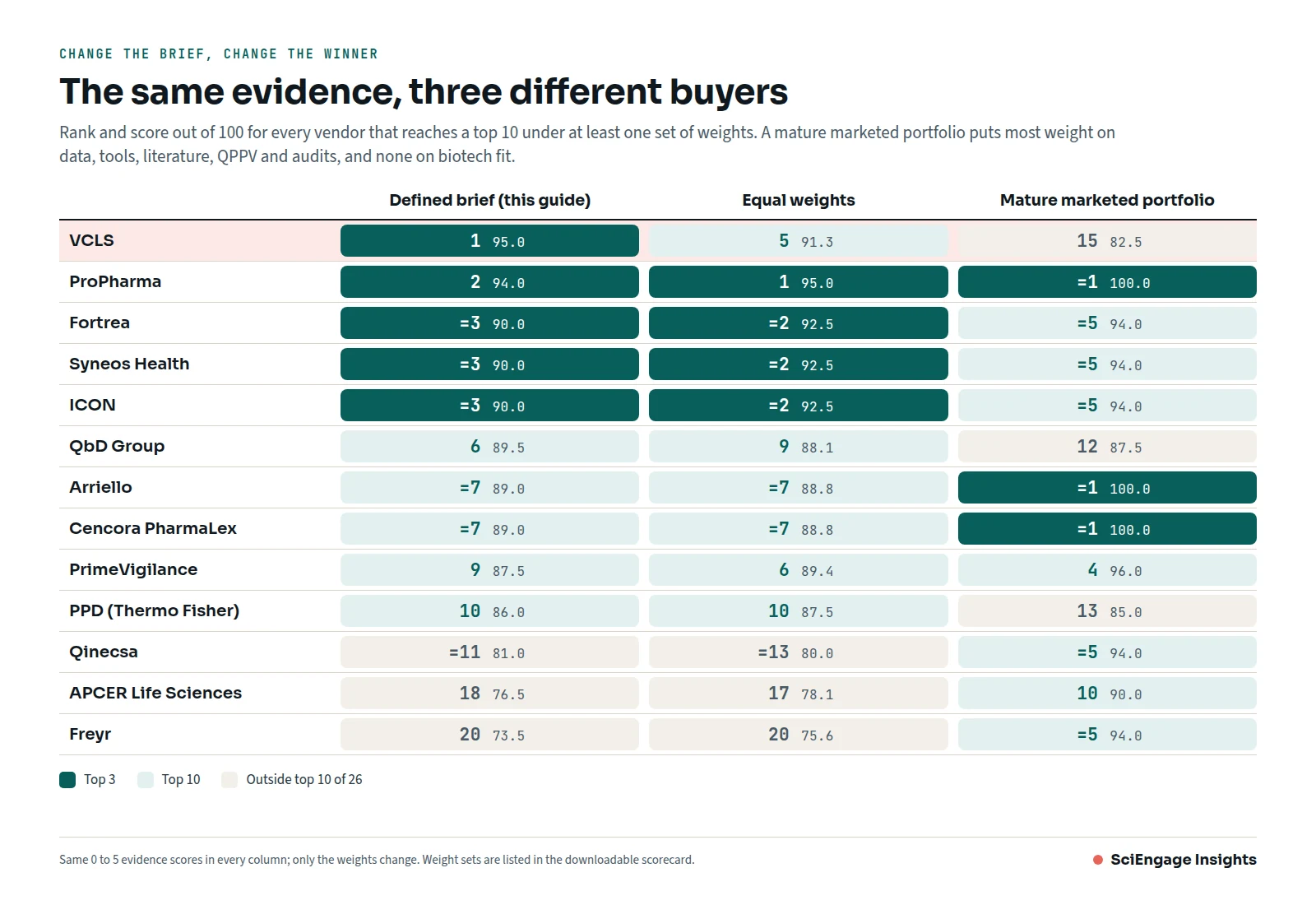
| Vendor | Defined brief | Mature marketed portfolio |
|---|---|---|
| VCLS | 1st (95.0) | 15th (82.5) |
| ProPharma | 2nd (94.0) | Joint 1st (100.0) |
| Arriello | Joint 7th (89.0) | Joint 1st (100.0) |
| Cencora PharmaLex | Joint 7th (89.0) | Joint 1st (100.0) |
| PrimeVigilance | 9th (87.5) | 4th (96.0) |
| Fortrea, Syneos Health, ICON | Joint 3rd (90.0) | Joint 5th (94.0) |
| Qinecsa | Joint 11th (81.0) | Joint 5th (94.0) |
| Freyr | 20th (73.5) | Joint 5th (94.0) |
| APCER Life Sciences | 18th (76.5) | 10th (90.0) |
With equal weights on all eight criteria, ProPharma leads on 95.0, Fortrea, Syneos Health and ICON tie second on 92.5, and VCLS is fifth on 91.3. That is the honest trade-off. VCLS leads when integration with regulatory, clinical and biotech support matters most, and the specialists lead when signal data, literature and QPPV depth matter most.
How to test a vendor's signal process
Public pages only show what a vendor chooses to describe. The quickest way to see a real signal process is to ask every shortlisted vendor the same six questions and request the same redacted artefacts. The stages below follow GVP Module IX, which also includes a confirmation step carried out by regulators.
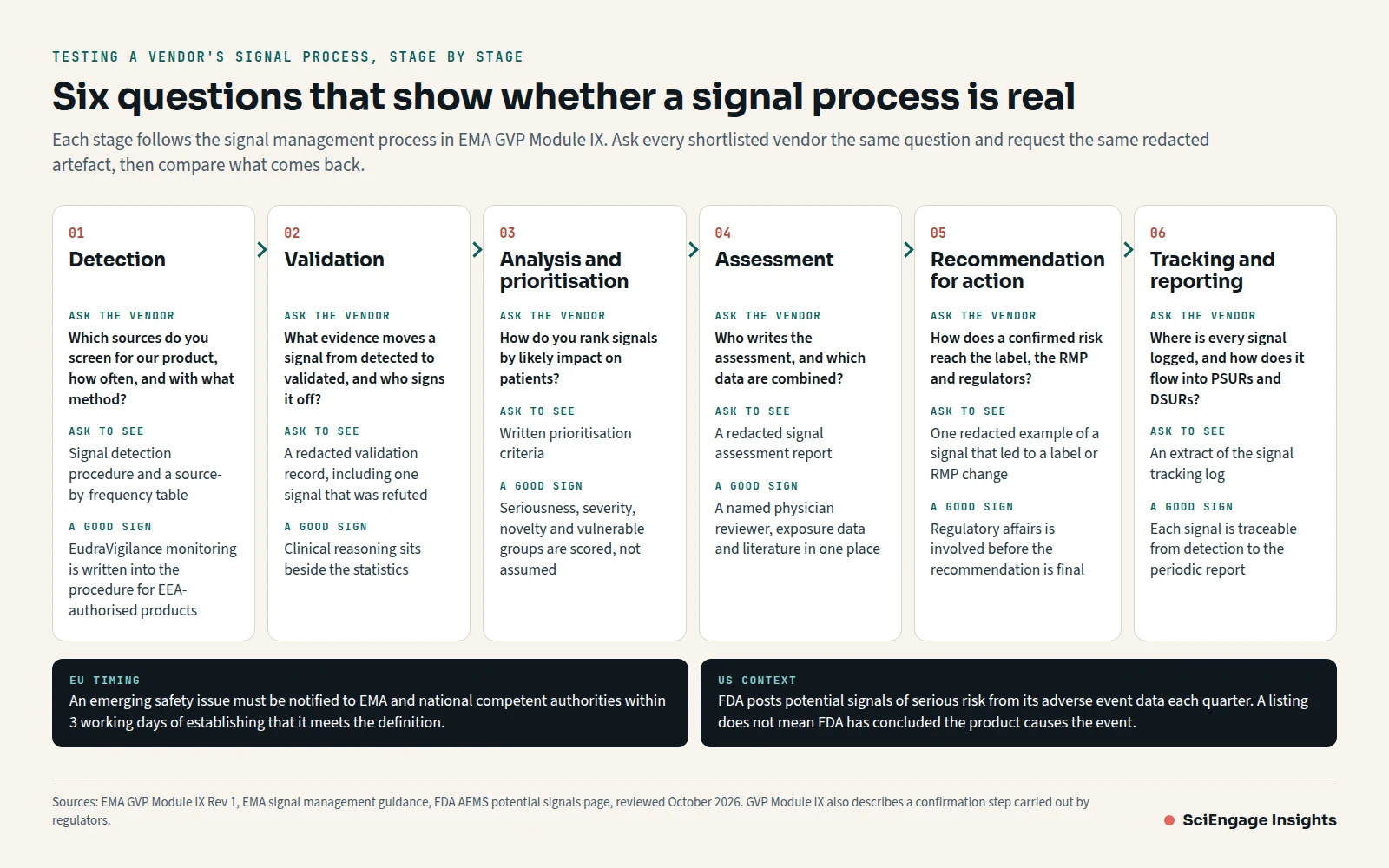
- Detection: Which sources do you screen for our product, how often and with what method? Ask for the procedure and a source-by-frequency table.
- Validation: What moves a signal from detected to validated, and who signs it off? Ask for a redacted validation record, including one signal that was refuted.
- Analysis and prioritisation: How do you rank signals by likely impact on patients? Ask for the written prioritisation criteria.
- Assessment: Who writes the assessment, and which data are combined? Ask for a redacted assessment report with a named physician reviewer.
- Recommendation for action: How does a confirmed risk reach the label, the RMP and regulators? Ask for one redacted example that led to a label or RMP change.
- Tracking and reporting: Where is every signal logged, and how does it flow into PSURs and DSURs? Ask for an extract of the tracking log.
Score each answer from 0 (nothing) to 3 (a redacted real example). The downloadable scorecard includes this checklist with formulas for up to three vendors.
What regulators expect in 2026
In the EU, signal management follows GVP Module IX. A marketing authorisation holder must notify an emerging safety issue to EMA and national competent authorities as soon as possible and no later than 3 working days after establishing that it meets the definition.
Implementing Regulation (EU) 2025/1466 ended the EudraVigilance signal detection pilot for marketing authorisation holders. EMA's questions and answers say all holders with EEA-authorised products should monitor EudraVigilance data as an additional source, at a frequency proportionate to risk, and describe that monitoring in their procedures.
The same change removed standalone signal notifications to EMA. Holders now handle those signals in their own process, act through variations where needed and present them in PSURs. EMA said GVP Module IX would be updated to reflect this, so check which revision is current before you finalise SOPs.
In the US, FDA's Good Pharmacovigilance Practices guidance covers signal identification, pharmacoepidemiologic assessment and pharmacovigilance plans. FDA also posts potential signals of serious risks each quarter. A listing does not mean FDA has concluded the product causes the event, but your vendor should watch the list.
As EMA's signal management page puts it, a signal is information about a possible new risk, not proof of one. A good vendor's job is to tell those apart quickly and document why.
What to put in the contract
A signal process is only as good as the obligations behind it. Whoever you choose, write these into the agreement:
- How often each product's data sources are reviewed, and who decides that frequency
- A target time from detection to a validation decision, reported monthly
- The emerging safety issue procedure, with named people and out-of-hours cover
- Your access to the signal tracking log at any time, not only at audit
- Who owns the safety database licence and data, and the exit and migration plan
- Which tasks are subcontracted, with your audit rights over subcontractors
Outsourcing does not move accountability. EMA is explicit that the marketing authorisation holder retains responsibility for its pharmacovigilance system when it delegates work.
How to use the scorecard
Download the editable signal vendor scorecard (XLSX, 58 KB). It holds all 26 scored vendors, the eight criteria with three weight presets plus a custom set, open formulas, a 17-capability matrix with source links, the reasoning behind every score, the software vendors and the six-stage RFP checklist.
Pick the weight set that matches your situation and the ranking recalculates. Then replace our desk-research scores with what you learn from RFP answers, artefacts and reference calls.
If you are earlier in the journey, the companion guides cover choosing a pharmacovigilance partner for your first US and EU launch and where post-market safety surveillance breaks down.
Bottom line
For an emerging biotech that wants signal decisions joined to regulatory, labelling and clinical work from trials to market, VCLS scored highest on our published criteria, with ProPharma one point behind. Fortrea, Syneos Health and ICON are the strongest large-CRO options if you want trial delivery and safety under one contract.
If your products are already marketed and you mainly need signal operations at depth, ProPharma, Arriello and Cencora PharmaLex lead, with PrimeVigilance close behind. Test your top three with the same six questions before you sign.
Frequently asked questions
What is signal detection in pharmacovigilance?
Signal detection is the search for new information suggesting a possible causal link between a medicine and an adverse event, or a new aspect of a known one. Sources include spontaneous reports, clinical trials, literature and databases such as EudraVigilance and FAERS. A detected signal still has to be validated, prioritised and assessed before anyone can call it a risk.
Does an emerging biotech need signal management before approval?
Yes, in proportion to the data it has. During development, sponsors review accumulating safety data from trials and summarise it in the DSUR. Once a product is marketed, spontaneous reports begin, and a formal signal process with defined sources, frequencies and sign-off becomes essential.
Do EU marketing authorisation holders still notify EMA of every validated signal?
No. Since Implementing Regulation (EU) 2025/1466, holders no longer submit standalone signal notifications from EudraVigilance monitoring. They manage those signals in their own process, act through variations where needed and report them in PSURs. Emerging safety issues must still be notified within 3 working days.
Should we buy signal software or outsource signal management?
Most emerging biotechs outsource, because software still needs trained safety physicians and a validated process to run it. Ask any service vendor which platform sits underneath, who holds the licence and how you would leave. Buying software directly makes more sense once you have an in-house safety team.
How much do signal detection services cost?
We found no public rate card from any of the 26 vendors in this guide. Cost depends on the number of products and countries, data sources screened, review frequency, literature scope and whether QPPV and aggregate reporting are bundled. Ask each vendor to price the same written scope so quotes are comparable.
What is the difference between a signal and a confirmed risk?
A signal is a hypothesis that needs investigation. It becomes an identified or potential risk only after assessment of all the available evidence. In the EU, confirmed signals are assessed by PRAC, which can recommend label changes, RMP updates or further studies.
Methodology, sources and updates
SciEngage reviewed each vendor's official pages on 22 October 2026, linked throughout this guide and listed in full in the scorecard. Vendor pages are treated as self-published capability claims, not proof of quality. We did not audit services, interview clients or see confidential fees, and we found no independent public comparison of signal detection quality, so none is quoted.
Scores were checked for consistency across vendors before publication. For example, rare disease and clinical operations pages were confirmed for every large CRO so that no vendor lost points for evidence that was available elsewhere on its site. Scores reflect documented scope for one defined brief and are not a universal ranking.
There are no affiliate links. If you represent a listed vendor and see a factual error, email anthony@sciengage.co with a primary source and the record will be reviewed. This guide will be reviewed again in 2027.