
Most small biotechs buy pharmacovigilance twice. First they buy clinical trial safety from whoever runs the study, then they rebuild it in a hurry when a marketing application is on the horizon and a QPPV, a PSMF and a post-market case flow suddenly become non-negotiable.
This guide is for the team trying to buy it once. We scored 11 providers against one specific brief, published the method and the evidence, and showed where a different brief would produce a different winner.
Quick answer
- Best overall for an integrated trial-to-launch brief: VCLS scored 91.0 out of 100, because it documents regulatory affairs, clinical trials and vigilance as in-house services, with safety support from first-in-human trials through post-market surveillance.
- Best for regulatory work plus full PV operations: Arriello (85.5), Cencora PharmaLex (84.0) and ProductLife Group (82.0) pair regulatory teams with QPPV, PSMF, literature and audit services.
- Best dedicated pharmacovigilance specialists: Qinecsa, PrimeVigilance and APCER Life Sciences score 100, 98.2 and 96.4 when only PV operations are scored, alongside Arriello, which suits teams that already have a regulatory partner.
- Best for platform-led or European-centred programmes: IQVIA for a SaaS vigilance platform with local affiliate reach, and ProPharma, ASPHALION and QbD Group for teams that also want device vigilance or EU launch support.
The brief we scored against
A ranking is only useful if you know what it was ranking for. Every score in this guide answers one question: which partner best suits a lean biotech with no in-house safety department, moving from clinical development towards a first US or EU marketing application, that wants one accountable partner for the transition?
That buyer cares about continuity more than scale. The same people who handled SAEs and SUSARs in phase 2 should be able to stand up post-market case processing, write the first PSUR, and sit next to the regulatory team when the risk management plan is submitted with the application.
If your situation is different, for example you are already approved and only need case processing at volume, skip to what changes when you score PV operations only.
How we picked and scored these providers
We started with 16 firms. Ten came from a competitor benchmark list used by VCLS, including VCLS itself, and we added six more from our own research into pharmacovigilance outsourcing.
Five were excluded because their public pages did not document a full post-market PV operation; they are listed under also assessed. The remaining 11 were scored from 0 to 5 on eight weighted criteria, using only official service pages reviewed on 22 October 2026 plus independent sources where we could find them.
The scale is simple: 0 means not offered, 1 means mentioned only, 3 means a documented service, and 5 means documented in depth with named tools, teams or case studies. A capability marked "not found" means it was not described on the pages we reviewed. It does not prove a provider cannot deliver it, so ask.
| Criterion | Weight | What earned a high score |
|---|---|---|
| Development integration | 20 | Regulatory, clinical delivery and safety under one roof |
| FDA and EMA regulatory depth | 15 | Documented US and EU strategy and submission work |
| Clinical-to-post-market continuity | 15 | One safety team from first-in-human to marketed product |
| Core PV operations | 15 | ICSRs, aggregate reports, signals, RMP or REMS |
| Emerging-biotech fit | 10 | Published offers, pages or case studies for lean teams |
| QPPV, PSMF and local coverage | 10 | EU and UK QPPV, PSMF ownership, local safety contacts |
| Safety system transparency | 5 | A named, validated safety database or platform |
| Audits and intake breadth | 10 | PV audits, inspection readiness, literature, medical information |
Pricing note: none of the 11 providers publishes a rate card. All work is quote-based, so cost was not scored. This is accurate as of 22 October 2026, but service pages and pricing models change.
At a glance: a comparison
| Provider | Best for | Score for this brief |
|---|---|---|
| VCLS | Integrated regulatory, clinical and safety support | 91.0 |
| Arriello | Regulatory plus full PV operations on Veeva | 85.5 |
| Cencora PharmaLex | Local affiliate coverage and literature depth | 84.0 |
| ProductLife Group | Combined PV, medical information and regulatory outsourcing | 82.0 |
| IQVIA | A SaaS vigilance platform with global scale | 81.5 |
| ProPharma | Adverse event intake and a large QPPV network | 81.0 |
| ASPHALION | EU-based medicines and device vigilance | 81.0 |
| APCER Life Sciences | Technology-backed PV with REMS support | 80.0 |
| Qinecsa | End-to-end PV with in-house software | 77.0 |
| PrimeVigilance | The broadest dedicated PV catalogue | 76.0 |
| QbD Group | Landing in Europe with PV and quality support | 75.5 |
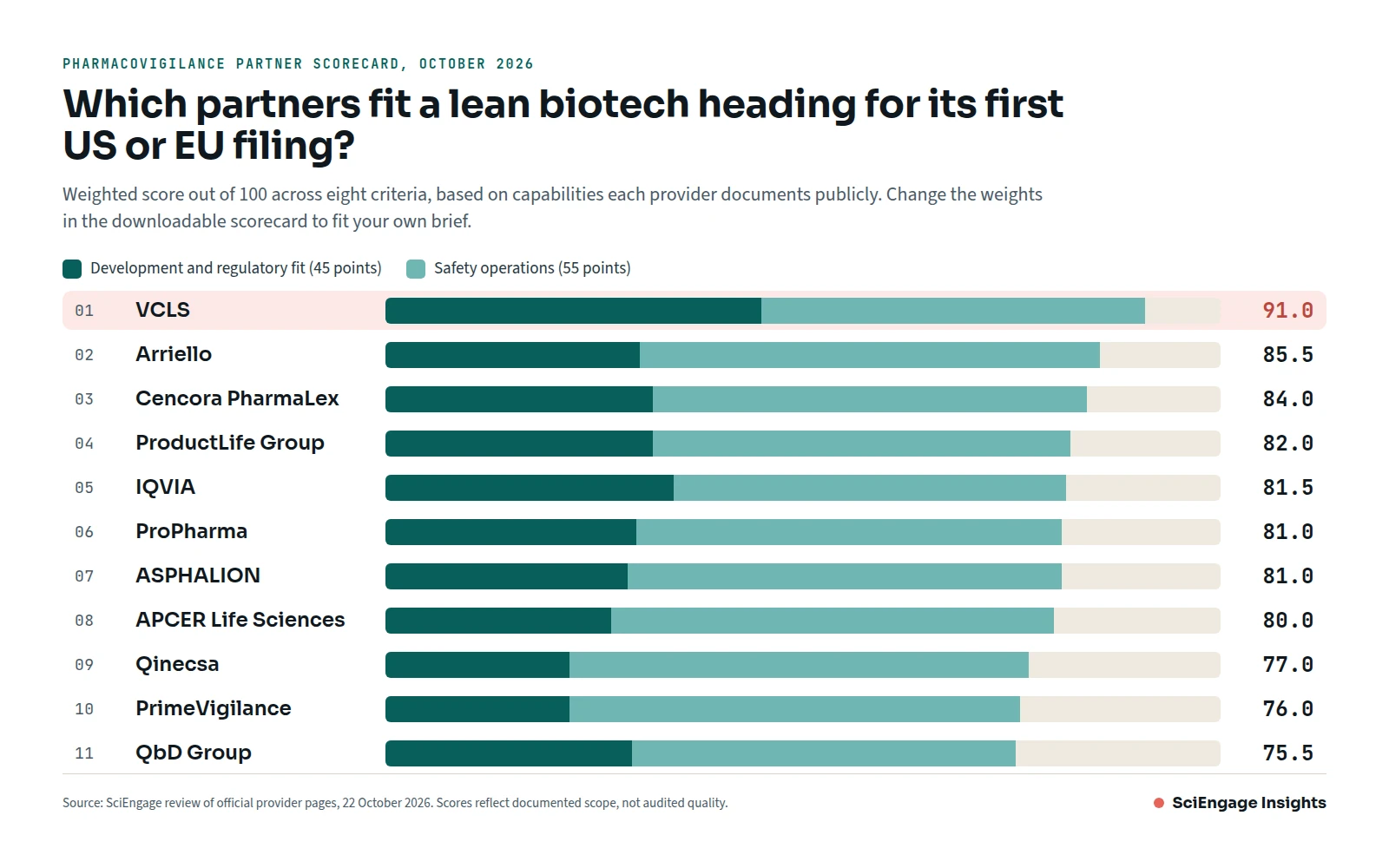
The spread is narrow. Ten of the 11 providers sit within 10 points of each other, and the order below second place is driven more by how much regulatory and clinical work sits in-house than by PV quality. Treat the middle of the table as a shortlist rather than a podium.
What the capability matrix shows
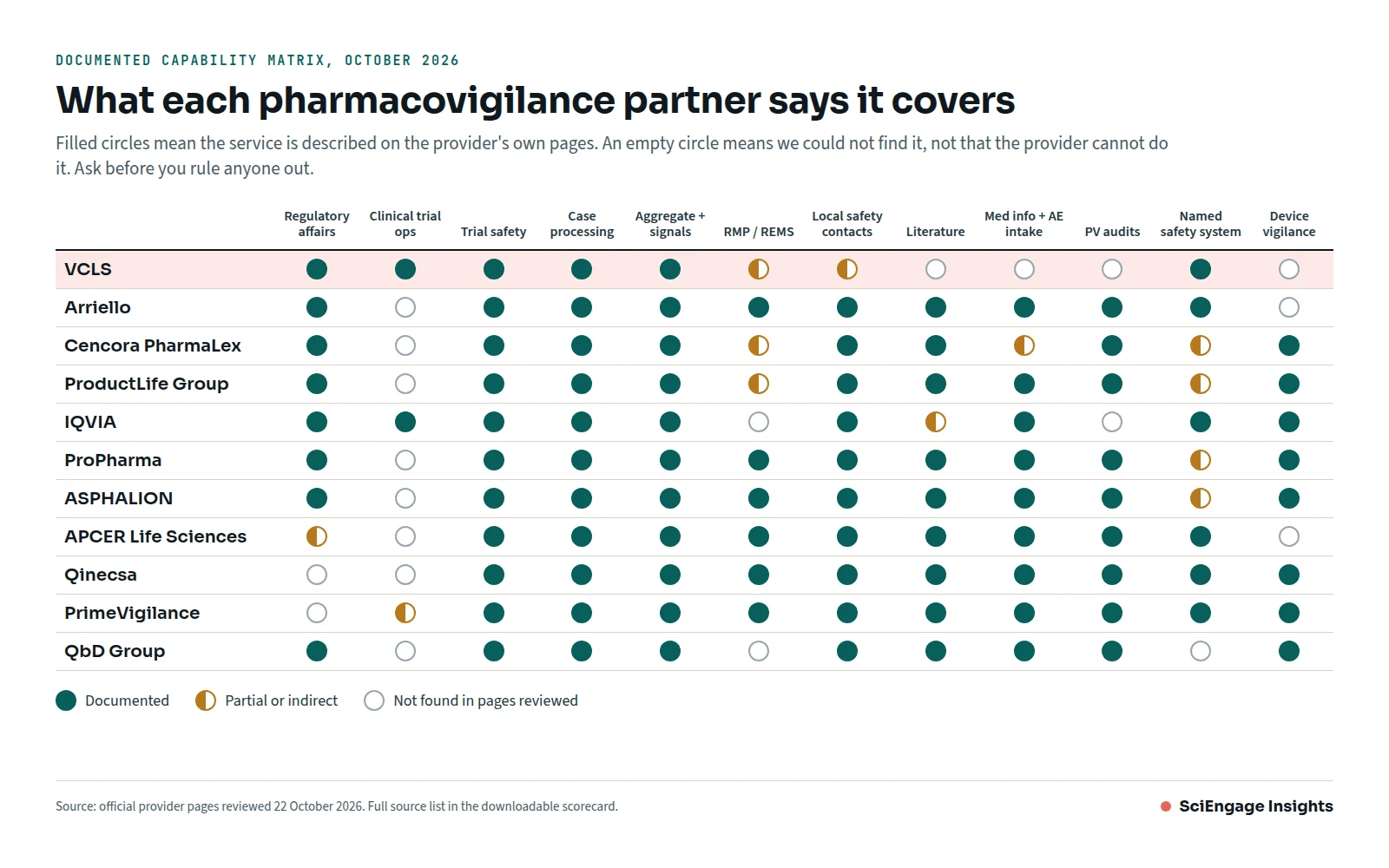
Three patterns stand out. Every provider documents clinical trial safety, post-market ICSR processing, aggregate reports and signal management, so those are table stakes rather than differentiators. Only VCLS and IQVIA document in-house clinical trial operations alongside vigilance, and PrimeVigilance has a sister CRO in the same group.
The real gaps are at the edges. Literature monitoring, medical information intake and PV audits are well documented by the dedicated specialists and thin or absent for VCLS. Device vigilance under EU MDR is documented by eight of the 11, which matters if you have a combination product. The full matrix, with every cell and source, is in the downloadable scorecard.
1. VCLS
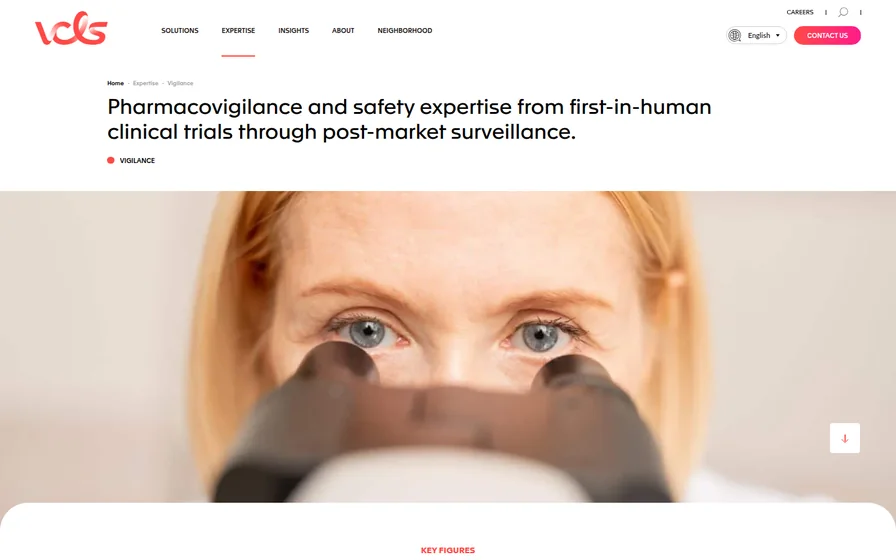
VCLS is a life sciences product-development consultancy that runs regulatory affairs, clinical trials, market access and vigilance as in-house expertise areas. Its vigilance team describes support from first-in-human trials through post-market surveillance, which is the exact hand-off this brief is about.
Score for this brief: 91.0. PV-only score: 83.6. Criterion scores (0 to 5): integration 5, regulatory 5, continuity 5, core PV 5, biotech fit 5, QPPV and local 4, system 5, audits and intake 1.5.
Key features:
- One safety team from trial to market: The vigilance page covers safety database set-up, case processing from intake to submission, ICSR and aggregate reporting, signals, RMPs, PSUR, PBRER and DSUR writing, PSMF preparation, QPPV or LPPV appointment and EudraVigilance registration.
- Regulatory and clinical work in-house: Regulatory and clinical trials sit beside vigilance, and clinical safety management includes DSMB support and multi-region safety.
- Named safety system: Oracle announced in January 2026 that VCLS selected Oracle Argus for its pharmacovigilance operations.
Pros:
- Strongest documented integration of regulatory, clinical and safety work
- Dedicated emerging biotech and start-up offers
- US, EU and China market entry from one organisation
Cons:
- Literature monitoring not described on the pages we reviewed
- No public detail on medical information intake or PV audits
- REMS and medical device vigilance not named
Pricing: Quote-based, with no public rate card.
Independent evidence: Oracle is a commercial partner, so its announcement confirms the platform choice rather than service quality. A MassBio member profile describes support from early stage through commercialisation and post-launch.
2. Arriello
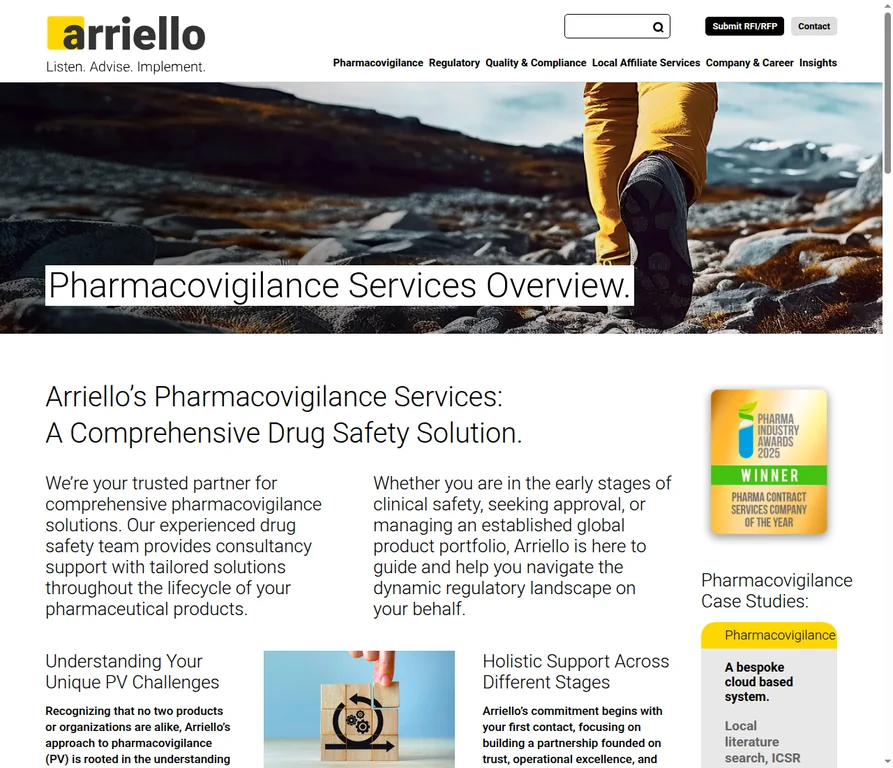
Arriello is a regulatory, pharmacovigilance and quality services provider with a full operational PV offer. Its regulatory work covers marketing authorisation applications, clinical trial regulatory support, scientific advice and orphan designation, which is why it scores second on a brief that rewards integration.
Score for this brief: 85.5. PV-only score: 100.0. Criterion scores: integration 3, regulatory 3.5, continuity 5, core PV 5, biotech fit 4, QPPV and local 5, system 5, audits and intake 5.
Key features:
- Full PV operations: The pharmacovigilance page lists QPPV, LPPV, ICSR case management, literature monitoring, signal detection, RMP and REMS, and aggregate reports.
- Clinical safety on Veeva: Clinical safety covers SAE and SUSAR management and safety management plans, and Veeva's customer story confirms its Vault Safety deployment.
- Intake, PSMF and audits: Separate pages cover medical information with AE intake, PSMF and GxP audits.
Pros:
- Joint top score when only PV operations count
- Regulatory submissions and PV from one provider
- Named, validated cloud safety database
Cons:
- No in-house clinical trial operations
- Medical device vigilance under MDR not documented
- Less visible FDA-specific regulatory detail
Pricing: Quote-based.
3. Cencora PharmaLex
Cencora PharmaLex is the regulatory, safety and development consulting business of Cencora, formerly known as PharmaLex. Its patient safety team describes PV from phase I through post-marketing, and Cencora's patient safety page cites native PV resources in more than 150 countries.
Score for this brief: 84.0. PV-only score: 94.5. Criterion scores: integration 3.5, regulatory 4, continuity 5, core PV 5, biotech fit 3, QPPV and local 5, system 3, audits and intake 4.5.
Key features:
- Local affiliate depth: Local affiliate services cover national PV contact persons, local literature and local ICSR handling.
- Literature beyond PubMed: Literature surveillance includes local non-indexed journals, which matters because EMA's literature service does not cover everything.
- Audit programme: PV audits cover affiliate, vendor and process audits with inspection support and CAPA follow-up.
Pros:
- Very broad local country coverage
- Strong QPPV, PSMF and audit documentation
- MedTech post-market surveillance under MDR and IVDR
Cons:
- Clinical trial operations not documented in-house
- Medical information listed, but not described as an intake service
- Safety database varies by engagement rather than one named platform
Pricing: Quote-based.
Independent evidence: The DIA Europe 2024 exhibitor listing describes lifecycle support for pharma, biotech and medtech through post-approval.
4. ProductLife Group
ProductLife Group (PLG) is a regulatory, vigilance and quality outsourcing group. Its pharmacovigilance team covers vigilance from clinical development through a product's marketed life and works alongside PLG's product development and regulatory affairs teams.
Score for this brief: 82.0. PV-only score: 90.9. Criterion scores: integration 3.5, regulatory 4, continuity 4.5, core PV 4.5, biotech fit 3, QPPV and local 5, system 3, audits and intake 5.
Key features:
- Database set-up for four agencies: The case processing page documents safety database configuration for EMA, MHRA, FDA and Health Canada reporting.
- QPPV and local safety officers: QPPV and LSO services include EU and UK QPPV, local PV persons, PSMF management, audits and inspection support.
- Medical information inside PV: A dedicated medical information service sits within the safety offer.
Pros:
- Choice of strategic or task-based delivery models
- A start-ups and investors offer
- Covers MDR and IVDR device work
Cons:
- Clinical trial operations not documented in-house
- RMP support shown in a case study rather than a named service
- Safety database platform not named
Pricing: Quote-based.
Independent evidence: Contract Pharma describes PLG as a global provider of vigilance, regulatory and quality services.
5. IQVIA
IQVIA combines a large CRO with technology and safety services. For lean teams its most relevant offer is the IQVIA Vigilance Platform, a SaaS safety system that IQVIA's September 2026 fact sheet positions for emerging biopharma and small pharma.
Score for this brief: 81.5. PV-only score: 85.5. Criterion scores: integration 4.5, regulatory 3.5, continuity 5, core PV 4, biotech fit 3, QPPV and local 4, system 5, audits and intake 3.5.
Key features:
- Modular vigilance platform: The platform page names modules for intake, case processing, periodic reports, detection and signal management.
- Local affiliate services: The LAPS fact sheet describes medical information call centres, local ICSRs, local QPPV and literature support in 170+ countries and 50+ languages.
- Trial-to-launch safety: Lifecycle safety runs from site selection through post-launch.
Pros:
- In-house clinical trial operations alongside safety
- Strong automation and technology investment
- Device post-market surveillance through SmartSolve
Cons:
- PSMF, RMP and REMS services not named
- PV-specific audit service not documented
- Needs careful scoping between platform, services or both
Pricing: Quote-based and demo-led.
6. ProPharma
ProPharma is a regulatory, clinical and compliance consultancy with a pharmacovigilance practice that runs from clinical development to post-marketing. It is one of the few firms here that documents a dedicated adverse event intake contact centre.
Score for this brief: 81.0. PV-only score: 92.7. Criterion scores: integration 3.5, regulatory 4, continuity 5, core PV 5, biotech fit 2, QPPV and local 5, system 3, audits and intake 4.
Key features:
- Large QPPV network: QPPV and LPPV services cover around 100 countries.
- AE intake and follow-up: The contact centre service runs on a validated database that integrates with Oracle Argus or Veeva Vault Safety.
- Literature and signals: Dedicated global literature review and signal management services.
Pros:
- Strong intake and medical information capability
- Device support for FDA MDR and EU MDR or IVDR
- Read-only database access for sponsor oversight
Cons:
- Least visible emerging-biotech positioning in this set
- Clinical trial operations not documented in-house
- Core PV safety database not named
Pricing: Quote-based; ProPharma says service options carry different price tags.
7. ASPHALION
ASPHALION is a scientific, safety and regulatory consultancy with offices in Barcelona, Madrid, Munich and London. It offers partial or full PV outsourcing for medicines, with device post-market surveillance run from the same service line.
Score for this brief: 81.0. PV-only score: 94.5. Criterion scores: integration 3.5, regulatory 3, continuity 5, core PV 5, biotech fit 3, QPPV and local 5, system 3, audits and intake 4.5.
Key features:
- EU QPPV and deputy: The service page covers EU QPPV and deputy, local PV in the EU and rest of world, PSMF and PV agreements.
- Inspection readiness: A dedicated inspections page covers readiness assessments, audits, QPPV training and CAPA follow-up.
- Medicines and devices together: Device PMS plans, incidents, FSCAs and PSURs sit alongside clinical trial drug safety and ICSR management.
Pros:
- ISO 9001-certified PV activities, per the provider
- Clinical trial drug safety included
- Strong fit for EU-centred programmes
Cons:
- US regulatory depth less visible
- Safety database described as validated but not named
- Clinical trial operations not in-house
Pricing: Quote-based.
Independent evidence: An EU research consortium partner profile lists vigilance and full outsourcing among its services.
8. APCER Life Sciences

APCER Life Sciences is a pharmacovigilance-led services company that also offers medical information, regulatory affairs, medical writing and quality assurance. It is unusually open about the technology it runs.
Score for this brief: 80.0. PV-only score: 96.4. Criterion scores: integration 3, regulatory 3, continuity 5, core PV 5, biotech fit 3, QPPV and local 4, system 5, audits and intake 5.
Key features:
- Named technology stack: The technology page names Oracle Argus 25.1, ArisGlobal LSMV and its own ANSA PV SafetyCore database.
- REMS and additional risk minimisation: The PV page lists REMS and aRMM support alongside RMPs and QPPV services.
- Round-the-clock medical information: Medical information covers 50+ countries and 30+ languages with AE triage.
Pros:
- A published US biotech case study on post-marketing intake
- Strong aggregate reporting and signal coverage
- Clear quality system description
Cons:
- No in-house clinical trial operations
- Device vigilance not documented
- Regulatory affairs offer less detailed than PV
Pricing: Quote-based.
Independent evidence: A Pharma Journal listing describes ICSR, literature, aggregate, signal, risk management, QPPV and PSMF support.
9. Qinecsa
Qinecsa, formerly Drug Safety and Pharmacovigilance Services Solutions (DSS), is a pharmacovigilance services and technology company. It pairs end-to-end case management, signal and risk management with its own software, including Reportum, HaloPV and Vigilance Workbench.
Score for this brief: 77.0. PV-only score: 100.0. Criterion scores: integration 2, regulatory 2, continuity 5, core PV 5, biotech fit 4, QPPV and local 5, system 5, audits and intake 5.
Key features:
- First-launch support: The PV overview says it supports biotechs preparing for a first product launch under US, EU and international rules.
- Quality and QPPV in one place: Quality and compliance covers PV audits, QPPV, local network, PSMF and inspection readiness.
- Lean-team case study: A resource-constrained biotech case study describes end-to-end clinical PV with deputy support.
Pros:
- Joint top score when only PV operations count
- In-house safety technology
- Device vigilance documented
Cons:
- No regulatory affairs service found
- No clinical trial operations
- Filing work needs a separate regulatory partner
Pricing: Quote-based.
Independent evidence: Pharma Tech Outlook profiled Qinecsa for a 2025 editorial award, which is recognition rather than a regulatory finding.
10. PrimeVigilance
PrimeVigilance is a dedicated pharmacovigilance and medical information provider within the Ergomed group. It has the broadest documented PV catalogue in this review, from case processing and literature to REMS, signals and device vigilance.
Score for this brief: 76.0. PV-only score: 98.2. Criterion scores: integration 2.5, regulatory 2, continuity 5, core PV 5, biotech fit 3, QPPV and local 5, system 4, audits and intake 5.
Key features:
- Local QPPV network: QPPV and PSMF services cover EU and UK QPPV and local contacts, with an official article citing a network in 160+ countries.
- Signals from many sources: Signal management draws on ICSRs, EVDAS, FAERS (now AEMS), Sentinel and VigiBase.
- Audit and inspection preparation: GVP audits and inspection preparedness run under an ISO 9001:2015 QMS.
Pros:
- Very broad PV and literature coverage
- Strong medical information capability
- Device and combination product vigilance
Cons:
- No regulatory affairs service listed
- Clinical operations sit with a sister CRO rather than the PV team
- Filing work needs another partner, which costs points on this brief
Pricing: Quote-based.
Independent evidence: An MTEC profile describes end-to-end PV and medical information services.
11. QbD Group
QbD Group is a quality, regulatory and compliance services group with a PV practice covering ICSRs, aggregate reports, signals, PSMF, QPPV and medical information. Its landing in Europe page links PV and medical information to EU launch support.
Score for this brief: 75.5. PV-only score: 83.6. Criterion scores: integration 3.5, regulatory 2.5, continuity 4, core PV 4, biotech fit 4, QPPV and local 5, system 2, audits and intake 5.
Key features:
- EU and UK QPPV: QPPV and local representative services come with a 24/7 hotline.
- Audits and mock inspections: PV audits, inspections and QMS reflect its quality background.
- Emerging biotech offer: An emerging biotech page targets early-stage teams, though it focuses on CTA and first-in-human work rather than first approval.
Pros:
- Technology-agnostic, so it can work in your database
- Strong quality and audit background
- Device post-market surveillance and vigilance
Cons:
- RMP and REMS not named
- No named safety database
- Regulatory offer is EU-centred
Pricing: Quote-based.
Change the brief, change the winner
The weights above reward a provider that can also handle regulatory and clinical work. If you already have a regulatory partner and only need safety operations, that assumption is wrong for you. So we rescored all 11 using only the five PV criteria: continuity, core PV, QPPV and local coverage, system transparency, and audits and intake breadth.
| Provider | Score for this brief | PV-only score |
|---|---|---|
| Arriello | 85.5 | 100.0 |
| Qinecsa | 77.0 | 100.0 |
| PrimeVigilance | 76.0 | 98.2 |
| APCER Life Sciences | 80.0 | 96.4 |
| Cencora PharmaLex | 84.0 | 94.5 |
| ASPHALION | 81.0 | 94.5 |
| ProPharma | 81.0 | 92.7 |
| ProductLife Group | 82.0 | 90.9 |
| IQVIA | 81.5 | 85.5 |
| VCLS | 91.0 | 83.6 |
| QbD Group | 75.5 | 83.6 |
On the PV-only view, VCLS falls to joint tenth. That is the honest trade-off: its advantage is integration with regulatory and clinical work, and its public pages say less than the specialists' do about literature monitoring, medical information intake and PV audits. If those matter most to you, start with the top four in this table.
Also assessed, but not ranked
These five firms appeared on the starting list but were not scored, because their public pages did not document a full post-market PV operation. That is a statement about fit for this brief, not about quality.
- SSI Strategy and NDA Group: Consultative safety and PV support, including RMPs and inspection readiness, without an operational case-processing catalogue.
- Scendea: Regulatory and safety writing such as DSURs and PSURs, but no ICSR or QPPV operations found.
- Alira Health: Clinical pharmacovigilance and device safety with real-world evidence work; post-market operations are not enumerated.
- Dark Horse Consulting Group: Cell and gene therapy regulatory and quality consulting, with no PV operations listed.
- Emergo by UL: Medical device post-market surveillance only, which follows a different legal framework from medicines PV.
How to use the scorecard in your RFP
Download the editable PV partner scorecard (XLSX, 16 KB). It contains the eight criteria, our 0 to 5 scores in blue input cells, open formulas, the 12-capability matrix and every source URL. Change the weights to match your brief and the ranking recalculates.
Then replace our desk-research scores with what you learn in the RFP. These questions separate providers quickly:
- Who is the named EU QPPV and deputy, and where do they reside and operate? EU law requires the QPPV to reside and operate in the Union.
- For the UK, will you provide the QPPV or a UK national contact? MHRA guidance allows a UK or EU/EEA-based QPPV, with a UK contact if the QPPV is outside the UK.
- Which safety database will hold our data, who holds the licence, and what is the exit and migration plan?
- Have you tested E2B(R3) postmarketing ICSR submission through FDA ESG NextGen, which FDA requires from 1 October 2026?
- Which literature sources do you screen beyond EMA's medical literature monitoring service?
- Which tasks are subcontracted, and what KPIs, audit rights and escalation routes sit in the contract?
If you are working through the launch itself, the companion guide on choosing a pharmacovigilance partner for your first US and EU launch covers operating models, hand-offs and a readiness checklist.
Bottom line
For a lean biotech that wants one partner to carry safety from late-stage trials into a first US or EU approval, with regulatory and clinical work in the same building, VCLS scored highest on our published criteria. Check that result against your own weights before you shortlist.
If your regulatory partner is already in place, the picture changes. Arriello, Qinecsa, PrimeVigilance and APCER document deeper PV operations, especially around literature, medical information and audits, and they lead the PV-only view.
Whoever you choose, outsourcing does not move accountability. EMA is explicit that the marketing authorisation holder retains ultimate responsibility for its pharmacovigilance system when it delegates tasks. Pick the partner whose people, systems and contract you can actually oversee.
Frequently asked questions
What does a pharmacovigilance provider do for a small biotech?
A pharmacovigilance provider runs the safety system the sponsor or marketing authorisation holder is legally responsible for. That usually means case intake and processing, regulatory submission of ICSRs, aggregate reports such as DSURs and PSURs, signal management, risk management plans, and providing or supporting the QPPV and PSMF.
When should a biotech outsource pharmacovigilance?
Most small biotechs outsource from the first clinical trial, then revisit the arrangement 12 to 18 months before a marketing application. That is when post-market requirements such as a QPPV, a PSMF, a risk management plan and expedited post-market reporting need an owner and a tested process.
Do you need an EU QPPV before approval?
Yes. An EU marketing authorisation holder must have a qualified person for pharmacovigilance permanently and continuously available, and that person must reside and operate in the EU. EMA's pharmacovigilance system Q&A expects the system to be functioning when the product is authorised.
How much does outsourced pharmacovigilance cost?
None of the 11 providers in this guide publishes a price list. Cost depends on case volume, number of countries, whether a QPPV and local contacts are included, the safety database model, literature scope and medical information hours. Ask each provider to price the same written scope so quotes are comparable.
Can one provider cover clinical trial safety and post-market pharmacovigilance?
Yes. All 11 ranked providers document both clinical trial safety and post-market case processing. The bigger difference is whether regulatory affairs and clinical trial operations sit with the same organisation, which is what this guide's weighting rewards.
Does outsourcing pharmacovigilance transfer regulatory responsibility?
No. In the EU the marketing authorisation holder retains ultimate responsibility for its pharmacovigilance system and master file when it delegates work, and US reporting duties sit with the applicant. A good contract defines who does what, but it does not move legal accountability.
Methodology, sources and updates
SciEngage reviewed each provider's official service pages on 22 October 2026, linked throughout this guide, plus independent sources where available. Provider pages are treated as self-published capability claims, not proof of quality. We did not audit services, interview clients or see confidential fees. We found no independent, public comparison of PV service quality, so none is quoted. Scores reflect documented scope for one defined brief and are not a universal ranking.
There are no affiliate links. Regulatory references are to 21 CFR 314.80, Directive 2001/83/EC, Implementing Regulation (EU) 520/2012, EMA guidance and MHRA guidance as linked above. If you represent a listed provider and see a factual error, email anthony@sciengage.co with a primary source and the record will be reviewed.