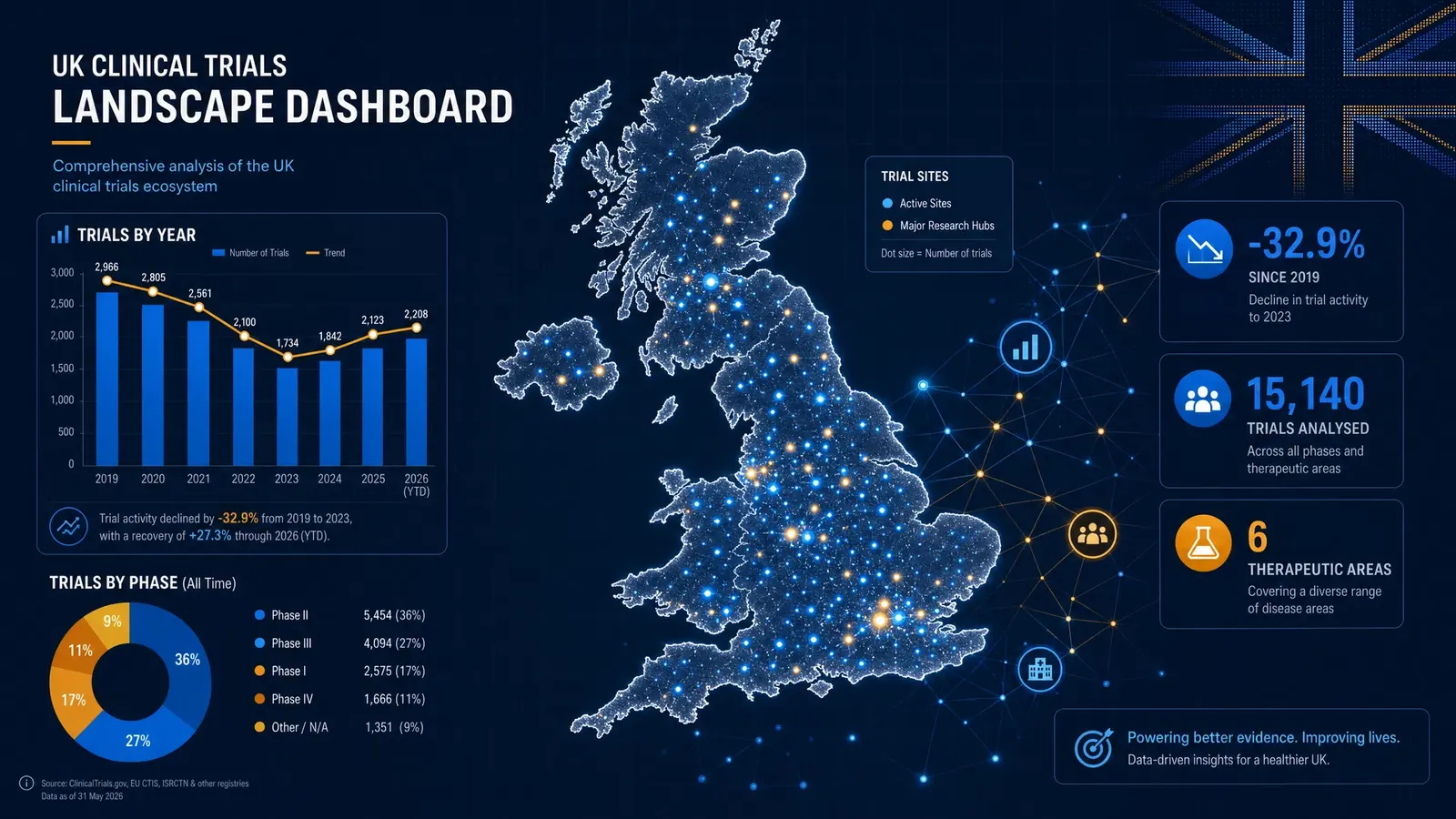
We have just launched clinicaltrialsuk.io — a free, publicly accessible intelligence dashboard covering the full landscape of UK clinical trials from 2019 to 2026. Built by SciEngage, it brings together 11,295 records from ClinicalTrials.gov and approximately 15,140 combined with the EU Clinical Trials Register (EUCTR), spanning England, Scotland, Wales, and Northern Ireland.
This is not a static report. It is a live, interactive tool designed for sponsors, CROs, NHS research teams, policymakers, and anyone who needs to understand where UK clinical research is heading — and why.
What the Dashboard Covers
The dashboard is structured across 18 analytical sections, each filterable by year (2019–2026), nation, and therapeutic area. Key sections include a Key Findings executive summary of the six most significant trends; a 2026 Spotlight with real-time projections based on confirmed Q1 data; a Year-on-Year Table tracking 14 metrics annually; a Peer Nations comparison against Germany, France, Australia, Canada, Spain, South Korea, and the Netherlands; UK Nations breakdowns for England, Scotland, Wales, and Northern Ireland; Therapeutic Areas analysis; Pipeline phase distribution trends; Recruitment enrolment size trends; dedicated COVID-19 and Brexit impact sections; EUCTR analysis of trials lost to regulatory divergence; Quality and Transparency metrics; Market sponsor analysis; and Geography showing regional trial density.
Six Findings That Should Concern the UK Life Sciences Sector
The data tells a clear and, in several respects, troubling story about the trajectory of UK clinical research.
1. Trial activity has fallen -32.9% since 2019. The UK has experienced one of the steepest declines among comparable nations. From a peak of 1,814 trials in 2021 (inflated by COVID-19 research), activity has declined every year since, reaching 1,221 in 2025. The 2026 projection of approximately 1,528 trials represents a modest stabilisation, but remains well below the 2019 baseline.
2. Brexit has cost the UK an estimated 2,331 trials. The EUCTR section models the counterfactual — what UK trial activity would have looked like had the UK remained within the EU regulatory framework. The divergence between the actual and modelled trajectory represents a structural, not cyclical, loss of research activity.
3. The UK's trials-per-million metric (21.0) lags significantly behind Canada (36.1) and Australia (26.7). Despite ranking third in European biotech by investment, the UK is underperforming on population-adjusted trial activity relative to its closest peers. Australia is the only major peer nation with positive trial growth since 2019 (+19.9%).
4. Only 27% of UK trials report results — well below the US mandatory rate of 41%. Results reporting in the UK remains voluntary, and the gap between industry-sponsored trials (36%) and academic-sponsored trials (12%) is stark. This transparency deficit has implications for evidence synthesis, regulatory confidence, and public trust in research.
5. Oncology dominates at 34%, but metabolic trials are surging +82%. The fastest-growing therapeutic area is metabolic/endocrine research, driven by the explosion of GLP-1 agonist trials for obesity and type 2 diabetes. This shift has significant implications for site infrastructure, patient recruitment strategies, and CRO capability positioning.
6. Trial durations are shortening — median down from 46 to 34 months since 2019. This is a positive signal, driven by adaptive design adoption (from 8% to 21% of trials) and NHS site activation improvements under the NIHR Clinical Research Network. The UK now completes trials approximately 15% faster than the global average.
Who Is This For?
The dashboard is designed to be genuinely useful across the clinical research ecosystem.
Sponsors and CROs can use it to benchmark UK site performance, understand therapeutic area trends, and assess the competitive position of UK sites relative to peer nations when making trial placement decisions.
NHS research teams and NIHR networks can use the geographic and nation-level breakdowns to identify where research capacity is concentrated and where investment is most needed.
Policymakers and industry bodies can use the Brexit and EUCTR sections to quantify the regulatory impact on UK research competitiveness and build evidence-based cases for reform.
Investors and business development teams can use the pipeline and market sections to identify emerging therapeutic areas, track sponsor activity, and spot signals of growing or declining research investment.
The Data Behind It
The dashboard draws on two primary sources: the ClinicalTrials.gov API (11,295 UK trials, 2019–2026, accessed May 2026) and the EU Clinical Trials Register (~10,987 UK trials pre-Brexit). All methodology is documented transparently within the dashboard, including how counterfactual estimates are constructed, how projected 2026 figures are calculated, and how peer nation comparisons are normalised for population.
Every chart includes a methodology note. Every key finding links to the supporting evidence. This is not a marketing document — it is an analytical tool built to the standards we apply to all SciEngage intelligence products.
Explore the Dashboard
The UK Clinical Trials Landscape Dashboard is free to access and requires no registration.
Explore the dashboard at clinicaltrialsuk.io
If you work in UK clinical research and would like to discuss what the data means for your organisation's strategy, get in touch.